Our society’s general perception of ‘What is a school?’ reflects the agrarian calendar and industrial model for work of the past.
I am an advocate for change. Some of us are just wired that way, others need degrees of convincing and a few just get dragged along by their fingernails because it has become reality, but they just can’t let go of the past. Because of this, it is the mission of the change advocates like me to present the vision and rationale for change and a great metaphor helps the process.
Have you ever heard the leg of lamb story?
“Grandfather,” he began, “In our long family history we have shared the lamb roast recipe down through the generations, preserving our lamb-roasting heritage. I wanted to share this moment with my new wife, but she complained. Grandfather, why do you cut the end of the leg of lamb.”
His grandfather thought for a moment, “Grandson,” he replied, “My father taught me and it was during the war. We only had a very small home and a very small kitchen. The leg of lamb wouldn’t fit, the oven was too small, and so we had to cut it
off.”
I often wonder if we are holding onto traditions and principles, ones that are apparently sacrosanct to schooling, when in reality, they may have come about because perhaps “the oven was too small”.
A few characteristics of schools today:
Hours of operation: 8.30/9.00-ish to 3.00/3.30-ish, from Monday to Friday
School day divided into sections, with block of time for teaching structured subjects and smaller blocks of time for eating, playing and connecting with friends in an unstructured way. These sections of time are punctuated with bells, horns, hooters to signify a change in activity.
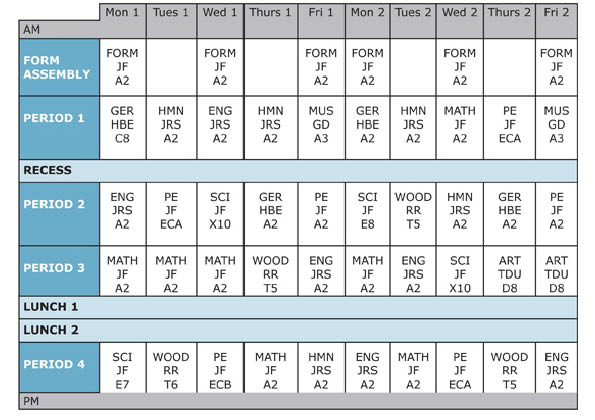 School year: Divided into terms, with vacation breaks and a longer break over summer
Students grouped according to age Secondary teachers are responsible for delivery of content according to the teacher’s expertise and qualifications.
Student grouping and teacher content expertise are physically organised into rooms along corridors, with equipment appropriate for the teaching of content.
Students and teachers housed in a purpose-built edifice, that keeps all the people within the same place.
Are these essential elements for a quality education?
Here is what I have discovered:
When compulsory schooling first began it was first scheduled around the agricultural calendar. The school day ended in the mid-afternoon so that children could come home before dark to milk cows, and do their other farm chores. Saturday was set aside for farm repairs, maintenance, harvesting, and planting. Sunday was a day for rest and religion. All family members were needed over the summers for harvesting, barn building, and other major farm projects.
The industrial economy began to replace the agricultural economy. At the beginning of last century the vast majority of the population left school between 12 and 14. The old structure adopted a new industrial model. Henry Ford’s assembly line became the model for operating schools. So from the one schoolhouse cottage industry, schools operated like factories. Students, the ‘products’, moved through a series of teachers on an assembly line of grade-specific classrooms. Principals managed the teachers, like the foreman managed the workers.
If we have moved on from the agricultural and industrial metaphor for school, what then is the replacement?
What environment does a young person need to thrive?
A Community?
A Family?
An organic garden?
The web?
A highly creative business/corporation?
I’d love to hear your thoughts. Let me know on Twitter @AnneKnock with #newmetaphor
 culture | learning | design
Interesting thoughts.
We now have people working all types of hours. Many from 8 to 5-6 pm.
Shift workers, casual employed and a host of single mums and dads. Country schools, especially in isolated areas, are often the hub of the community. It would be great if this was true for all schools in cities.
LikeLike