“Failure to connect course content to the real world has repeatedly been shown to contribute to students leaving the sciences”
(Prince & Felder, 2007)
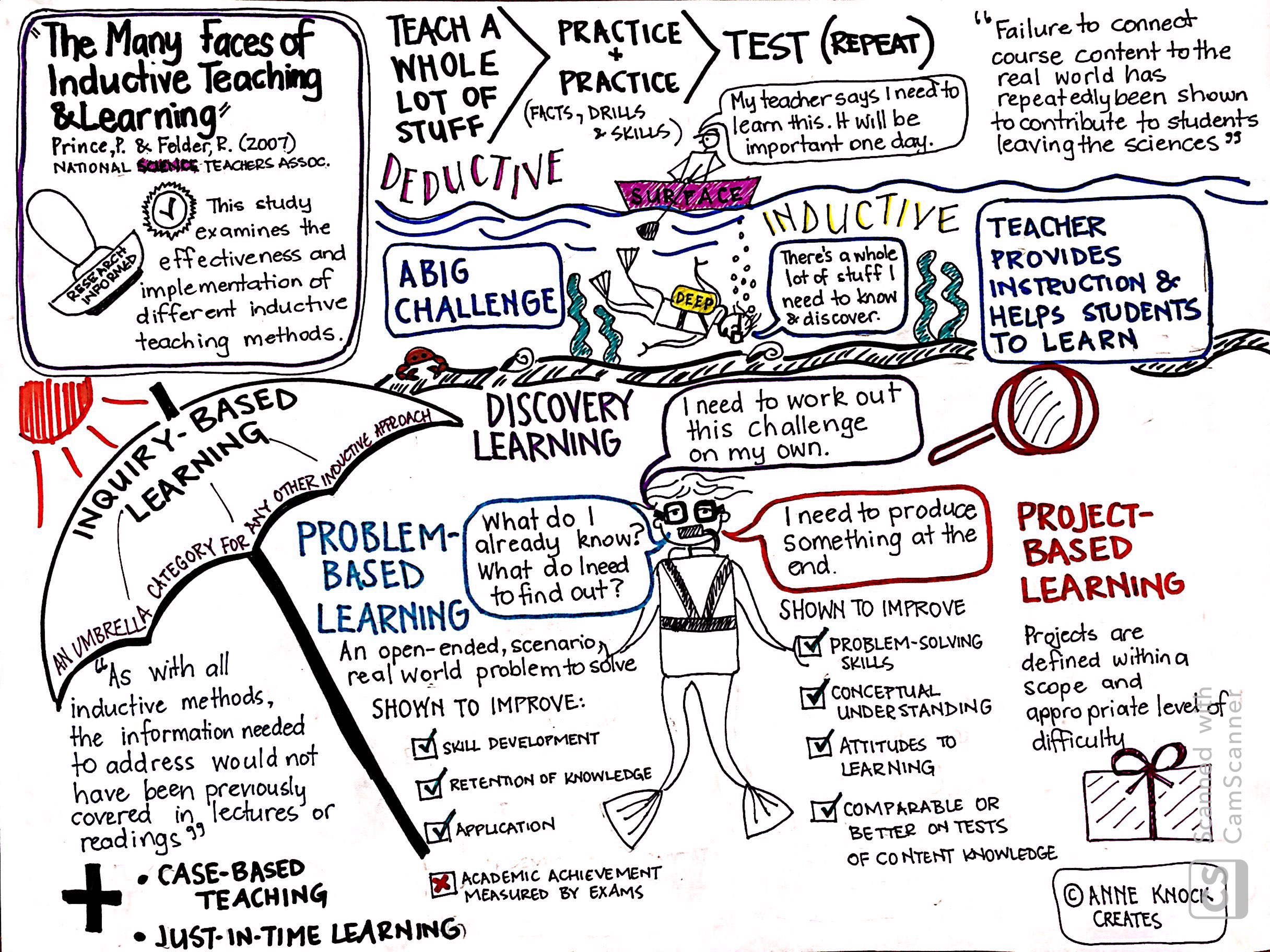
In this article “The Many Faces of Inductive Teaching and Learning”, Prince and Felder examine the effectiveness of different inductive teaching methods. It is focused on college (university) level science teaching, but provides helpful insight into inductive teaching approaches for school education.
The difference between deductive and inductive teaching and learning can be simply explained by ‘who’s in charge’:
- Inductive – teacher presents the content knowledge
- Deductive – learners identify what they need to know
The umbrella category ‘inquiry based learning’, presents the model of a big challenge, where the solution, outcome or even the information required, is not necessarily known by the learner ahead of time. Five approaches are reviewed, the first three have particular relevance:
- Discovery-based learning – teacher provides little feedback or direction as students are required to work out the solution in their own.
- Problem-based learning – students are usually working in teams, define the problem and determine what they need to know. The teacher provides guidance.
- Project-based learning – the output is a ‘product’. Students apply previously acquired knowledge.
The remaining two relate more to the college/university context:
- Case-based teaching – study of historical and hypothetical cases, where students are challenged to explore existing preconceptions to accommodate the realities of the case.
- Just-in-time learning – students undertake electronic pre-test so the teacher is able to adjust the content to address misconceptions revealed in student responses.
Prince & Felder (2007), Many Faces of Inductive Teaching and Learning
Journal of College Science Teaching
 culture | learning | design