What could be made possible if schools were driven by empathy?
- Leadership: A consultative culture prevails
- Teachers: Focus on learning design not content delivery
- Students: Feel like they belong and their voice is valued, become co-designers
Imagine the scene, I’ve found the perfect sofa. Colour and style matches with my dream for the space. I’ve sat on it, it’s comfy, colour and style are appealing, so I say ‘yes’ and arrange delivery, When the sofa arrives, it doesn’t fit. What happened? Perhaps, before committing to the purchase, I needed to assess the room capacity against the sofa’s specifications.

Design thinking, also known as ‘human-centred design’, puts people first,
For design thinkers, behaviours are never right or wrong, but they are always meaningful.
(Tim Brown, Change by design p.39).
Brown describes empathy as standing in the shoes of others, gaining deep understanding from behaviours and feelings, and taking notice of people in their natural habitat. He suggests that the progression from insight and observations to empathy means that the subject of the design might then become a co-designer, resulting in an enhanced level of collaboration.
Even if we are very experienced, maybe we’ve designed schools before, we know kids and teachers, so the idea of spending a considerable amount of time on empathy mapping feels like it’s slowing progress on the project, and ultimately the cost to reach the solution. Without it, the solution may not be fit-for-purpose.
When we show empathy, we deeply know another’s feelings, we feel what they feel and then respond compassionately to their situation. To sympathise is to care, but to empathise is to genuinely feel what others feel. When we deeply understand someone else’s experience
we utilise the same brain wiring that is active during our own experience
(Goleman, p.59)
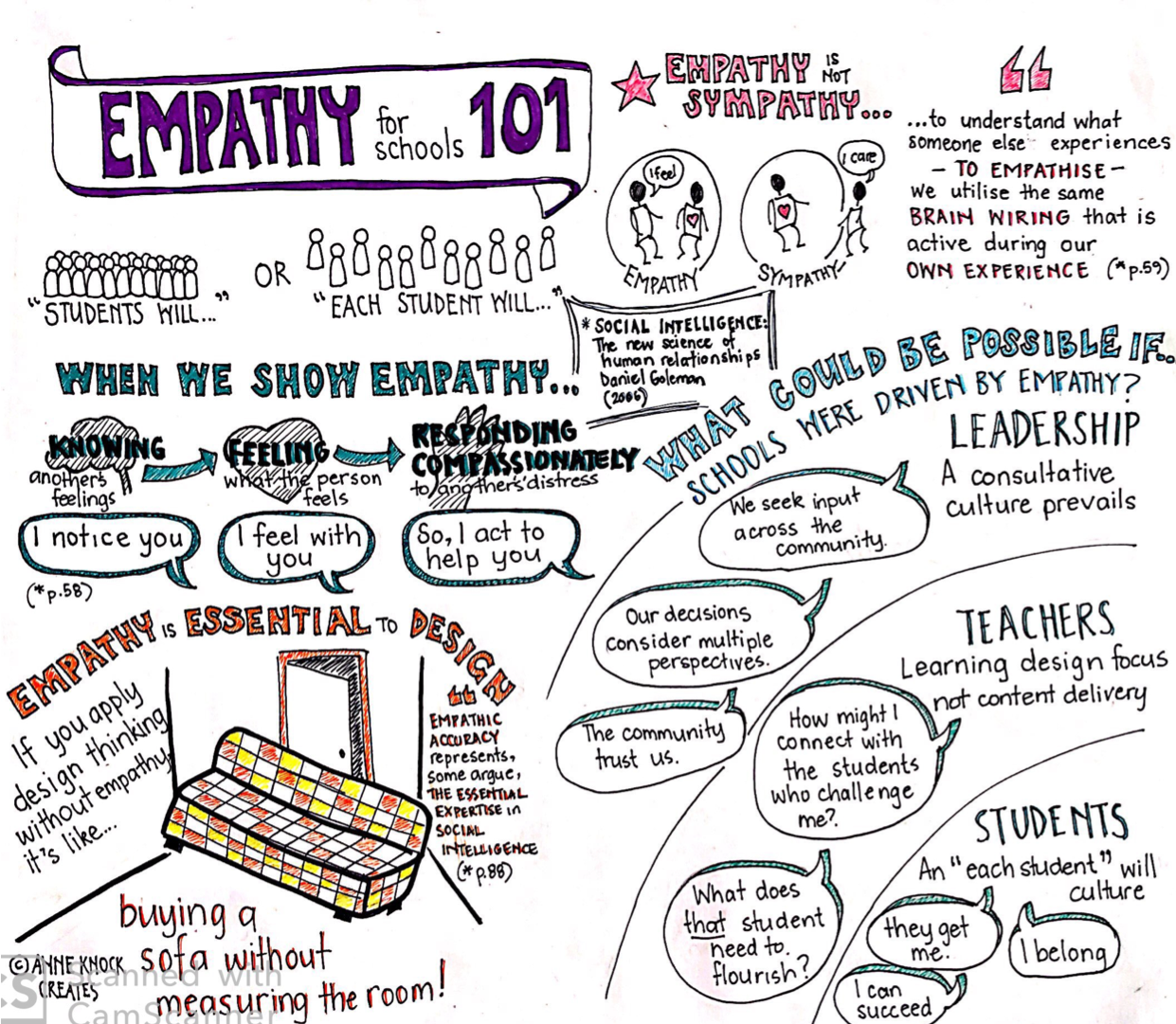
What happens when we shift the language from…
students will to each student will ?
(Acknowledging Greg Miller for this provocation)
I know what you’re thinking, an individual learning plan for every student in the school? This would be impossible. We can learn from the experiences of other sectors. Design thinking has transformed many government services. While not isolating the needs of all customers, personas are developed to represent key demographics, so services become more inclusive. In one project, this enabled the design team to
develop deep empathy for people they are designing for, to question [their own] assumptions, and to inspire new solutions
Service Design for Public Policy
How might we gain deep empathic insights, using design thinking:
- Re-inventing the school arrival experience?
- Teachers transforming thinking and practices in new learning environments?
- Learning design for inquiry-based approaches?
- Re-imagining the timetable?
- Establishing new systems to address embedded routines?
- Creating the desired culture?
Tools include:
Journey map – trace the subject’s journey on a matrix that progresse through time (horizontal) and response at key interaction points (vertical)
Expectation map – What does the subject see, hear, say, do, think and feel? What might they hear from other voices?
Scenarios – Create a scenario, from information gathered to storyboard their experience. This helps to align the design team around a clear vision
Pain Point Mapping – What does a student experience across a day. Map each instance on the severity and probability/frequency
Simple ethnography – As a design team, observe and record interactions and activities to identify issues and opportunities.

 culture | learning | design